
Most traders who try to grow faster do it the dangerous way: bigger size on every trade, or several trades at once. Both raise the amount at risk at the same moment, and drawdowns grow with the returns. We tested a different idea on four years of gold data: only add size to a trade that can no longer lose. We call it the Free Add.
- Why most ways of trading bigger fail
- The Free Add rule
- What four years of data showed
- The test that surprised us
- Risks and when not to use it
Why most ways of trading bigger fail
Doubling your risk per trade doubles your returns and roughly doubles your drawdown, so the ratio between them doesn't improve. Running several trades at once is worse than it sounds on gold: setups cluster around the same moves, so three open trades often lose together. When we let our model hold up to three trades at once, it made about 10% more R, but its worst drawdown rose by more than that, and it broke the floating-loss rules of a typical funded account.
The Free Add rule
- Take the normal trade with its normal stop.
- When price has moved one full risk unit in your favour, the stop moves to breakeven. Only then can the add be considered.
- Add one position on the next small pullback in the same direction, with its own tight stop below the recent swing.
- The add shares the main trade's final target, moves to breakeven after its own +1R, and is closed when the main trade closes.
- One add per trade. Never more.
Because the first position is at breakeven before the add opens, the account never has more than one position's worth of money at risk.
What four years of data showed
From July 2022 to September 2026, with spread and slippage on every trade, the core model made about +91R. With the Free Add the same signals made about +141R. The largest drawdown didn't rise: 5.9R against 6.3R. The adds, 78 of them, helped in every calendar year and in both halves of the data, including the 2025–26 period that wasn't used to develop the rules.
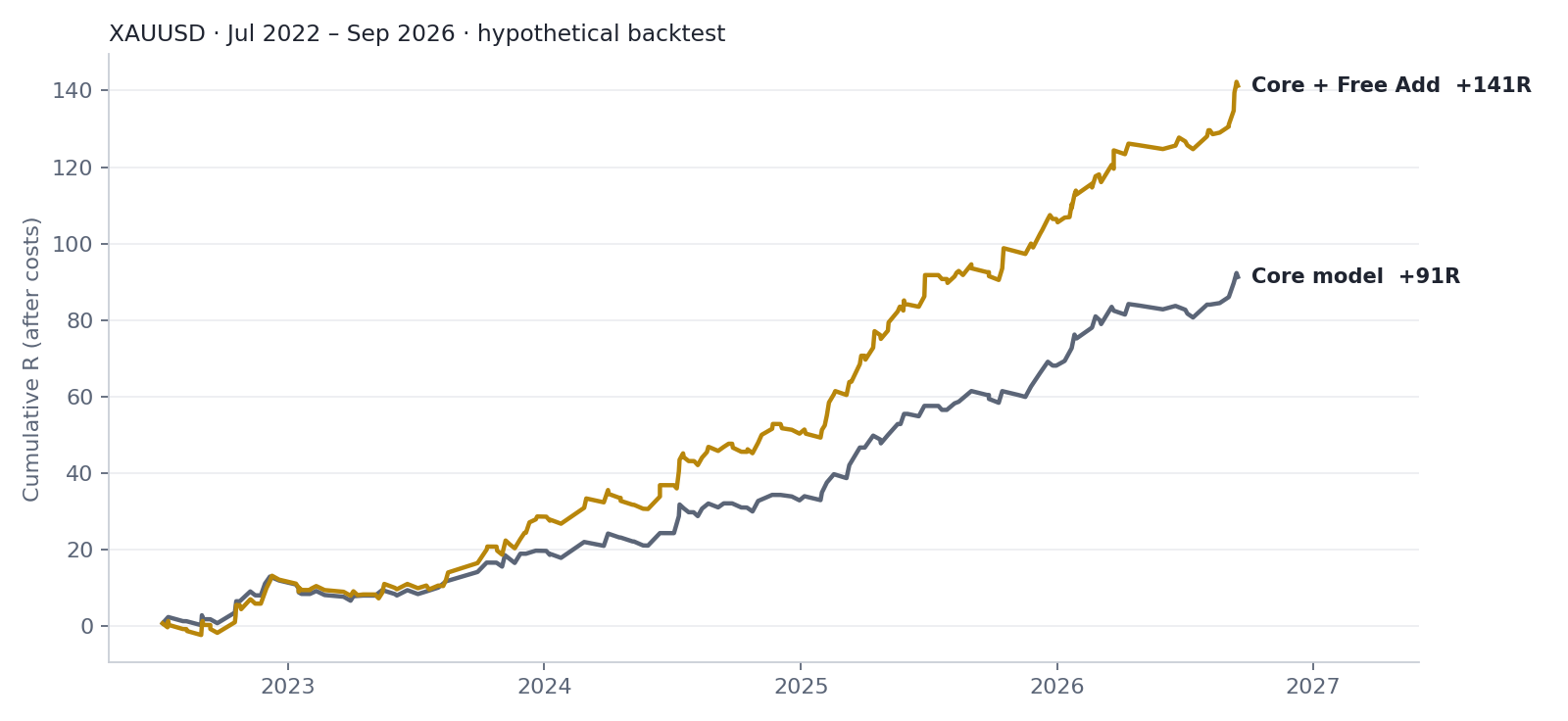
The MT5 Strategy Tester told the same story for January–September 2026 on a $10,000 account at 2% risk: +89% with the Free Add against +50% without, with a lower balance drawdown (5.7% versus 6.5%).
The test that surprised us
We time the add with a fresh fair value gap after breakeven. To check whether that timing mattered, we replaced it with random add times after breakeven. The random adds earned about as much on average. That was humbling and useful: the edge doesn't come from a clever entry pattern. It comes from the fact that a gold trade that has already moved one risk unit in your favour tends to keep going. That kind of edge is more likely to hold up than a finely tuned pattern.
The timing rule still matters in practice. Adding at a random moment sometimes produced tiny stops and wild results; the FVG rule gives a clear, repeatable entry with a sensible stop.
Risks and when not to use it
- Floating drawdown rises a little. While an add is open and not yet at breakeven, it can move against you. At 2% risk, 2026 equity drawdown went from 9.2% to 10.9%. On a prop account with a 10% limit, use 1%.
- You need a hedging account, because the add is a second position on the same symbol.
- Some prop firms count the add as part of the same trade idea for per-idea risk limits. Because the first position is at breakeven, the idea's total risk stays at about one position.
- It is still a backtest. Live fills and spreads will cost something. Plan for less than the tested result.
The lesson goes beyond this model: if you want more from a working strategy, add to trades that are already risk-free rather than raising the risk on every trade.
Trade the tested model
Use the same rule set as live signals, an MT5 indicator or a fully automated MT5 EA.
Figures in this article are hypothetical backtest and simulation results. Trading involves substantial risk. This is educational content, not financial advice. See the risk disclosure.